emoteCare · End-to-end product design
Improving therapist discovery for higher conversion
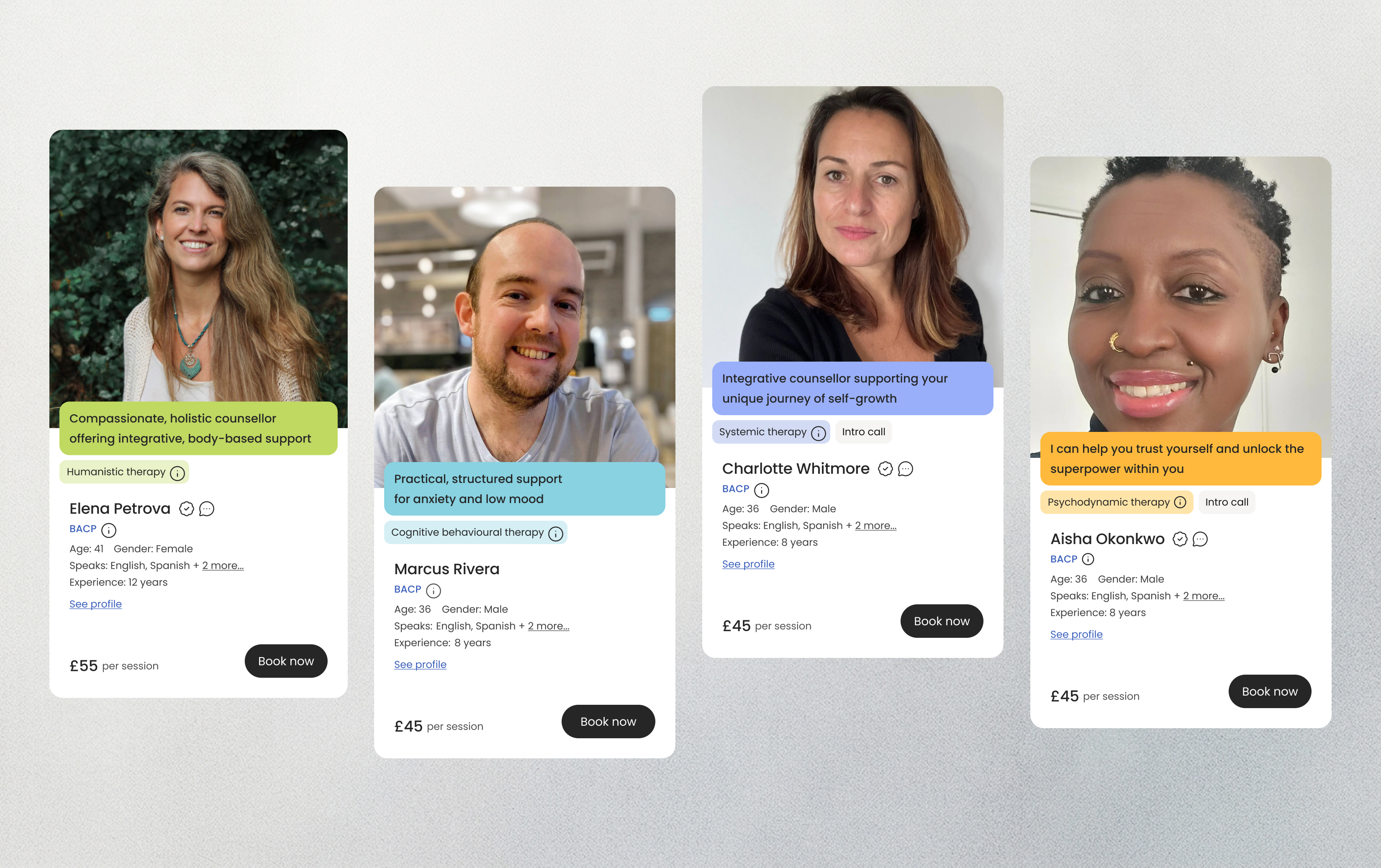
As sole designer, I led the end-to-end redesign of an early-stage therapy marketplace, working directly with the founders and a team of five engineers to take it from concept to production.
Two things were failing at once. People could not tell who any of these therapists actually were, and the path from browsing to booking was long enough to lose them along the way. I worked on both: profiles rebuilt around video and photography so a therapist feels like a real person, and an AI-guided matching flow with three-step booking so the mechanics never get in the way of the decision.
Research ran through the project rather than after it: interviews before I started, a second round reviewing the first redesign, then moderated usability testing with 50 participants. The second round confirmed people felt more confident choosing a therapist, and every usability test participant completed the booking flow unaided. The redesign shipped to production on a design system I adapted for React with the engineering team.
About the product
emoteCare is a UK online therapy platform that connects people with verified therapists for video sessions, from browsing profiles to booking free intro calls and paid sessions. Finding the right therapist is an emotional, high-stakes decision, so the product had to build trust quickly while reducing friction in discovery and booking.
Why users weren't booking
I started with interviews. Despite steady traffic, people were dropping off before booking, and the reasons were consistent: too much choice, no way to judge who to trust, and no clarity on price or what happens next.
- High drop-off during therapist browsing
- Low conversion from profile view to booking
- User uncertainty when comparing therapists
- Friction in the booking flow
For the business that meant losing bookings on traffic it had already paid for. It also told me the problem was not one thing but two: people could not judge who to trust, and the path to booking was too long to hold them.
Matching
Narrowing the choice before it overwhelms
Most people arriving at emoteCare did not know what kind of therapy they needed, let alone which therapist. Faced with a grid of unfamiliar names, they left without booking. I designed a guided matching flow, built with the founder — a practising therapist — that asks about the person's situation first and narrows the field before choice becomes paralysing.
Try the flow
Click through it below. It starts with a few open questions about your situation, explains each type of therapy as you go, and asks what matters to you in a therapist. Your answers come together in a summary, then a shortlist of therapists who fit — in the live product, recommended by AI. I designed the flow in Figma and tested it with users before build; this version is rebuilt from those frames with Claude.
Trust
Making a stranger feel like a real person
Choosing a therapist is not like choosing a restaurant. People were scanning a list of near-identical names and credentials with no sense of who any of them actually were, and hesitating. I rebuilt the therapist card around presence rather than data: a large photograph, a video introduction, and the person's own words placed above their qualifications.
What I changed
- Led with large photography and video introductions instead of a headshot and a job title
- Put each therapist's own introduction above their credentials and pricing
- Colour-coded therapy types so specialisms are recognisable at a glance
- Reduced each card to a single primary action, so the next step is never ambiguous
The second interview round changed this. Reviewing the first redesign, people said the profiles were too thin — they wanted more to go on before committing to someone. With the team I added substance: fuller introductions, more detail on approach and experience, clearer sense of what a first session involves. Presence is what gets someone to look; substance is what lets them decide.
.png)
The profile does the convincing
By the time someone opens a profile, they are deciding whether to trust a stranger with something personal. The profile had to answer two questions at once: is this person qualified, and will I feel comfortable with them?
Most therapists wrote their profiles from a blank page, so they read inconsistently and were hard to compare. I replaced the free text with structured prompts, filled in during profile setup: who I am, how I work, my specialities, when I may not be the right fit. Every profile now answers the same questions in the same order, without losing the therapist’s voice.
- Personality first, credentials close behind. The intro video leads; verification and membership sit one tap away, so trust checks never interrupt the first impression.
- The same language as the matching flow. “How I deliver sessions” uses the same practical–explorative map people saw in matching, so they can see why this therapist fits.
- Honest about fit. Each therapist states when they’re not the right choice. It reduces mismatched first sessions and makes the rest of the profile more believable.
- Booking without pressure. Price, next availability and the cancellation policy stay fixed at the bottom, so the commitment is clear before anyone taps “Book now”.
Try the profile below.
Booking
Reducing friction in the booking flow
Booking is where interest turns into a commitment, and a payment. Each step answers one question: when, what it costs, and what happens next. Tap Book now in the profile above to try it.
- Only real availability. Days without free slots are crossed out, and times show in the person’s own timezone.
- Recurring sessions, stated upfront. Weekly booking is one switch, with “auto-charged until cancelled” written right beside it.
- A full recap before payment. Date, time, session type, cancellation terms and total sit on one screen, with Apple Pay next to card checkout.
- Ready for the first session. The confirmation asks for a short pre-session form with emergency details, which can be done now or later.
Validation
Usability testing confirmed that users could complete the booking flow independently, with a 100% task completion rate and minimal hesitation.
Both sides
Designing for the therapists too
A marketplace only works if both sides show up. Therapists were being asked to build a profile good enough to earn a stranger's trust, with no guidance on what actually made one work — and once they were live, no clear view of their sessions. I designed the supply side alongside the demand side: a guided profile setup that makes the requirements explicit, and a dashboard that shows upcoming and completed sessions at a glance.
What I designed
- A step-by-step profile setup checklist, so therapists can see exactly what is still missing
- Guidance on photography and video, because those are what earn client trust
- A sessions dashboard covering upcoming and completed appointments
- Clear completion states, so a therapist knows when their profile is ready to go live
The same principle applied on both sides: the profile is the product. Helping therapists build a better one directly improved what clients saw.
.png)
Design system and delivery
A system the engineers could build from
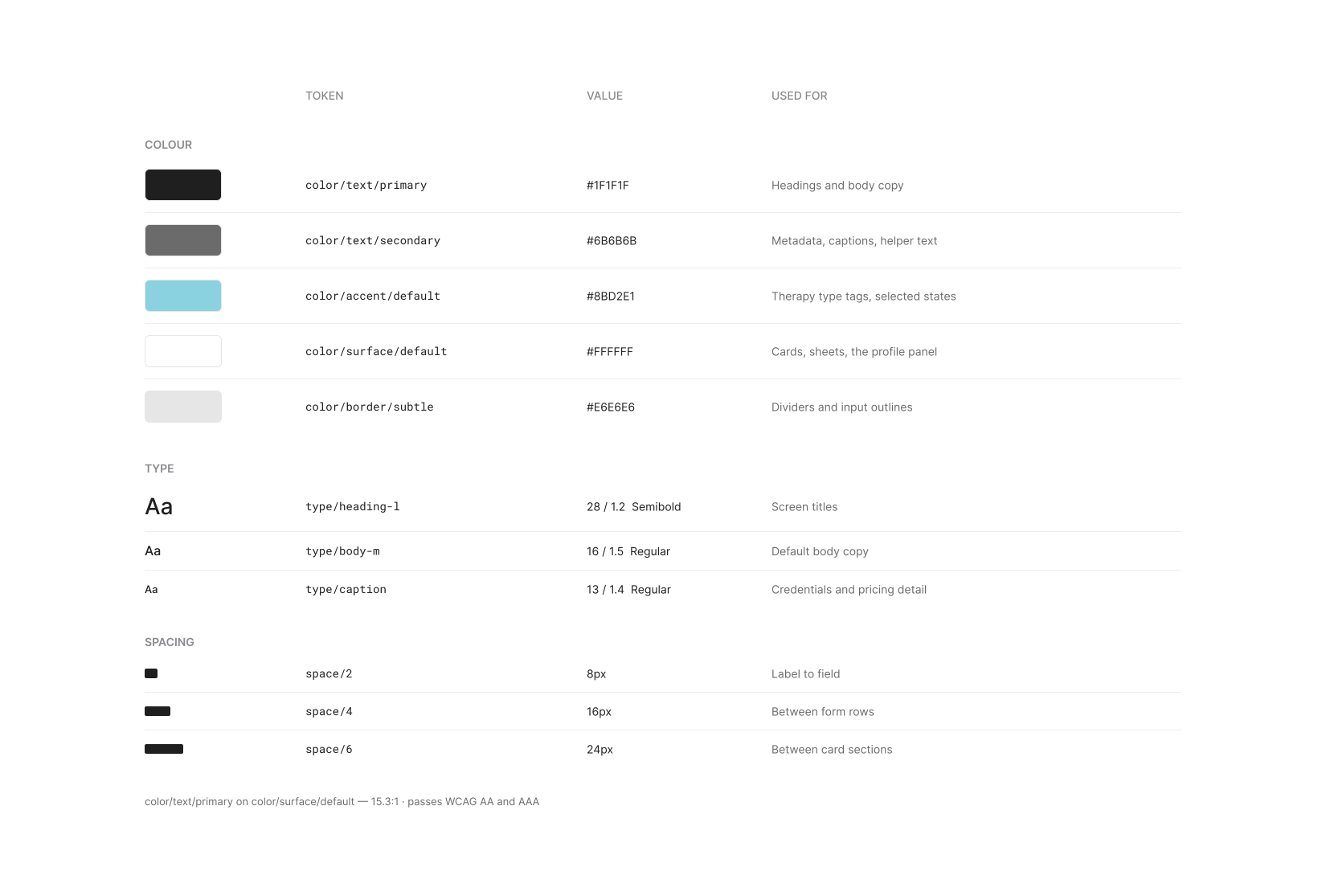
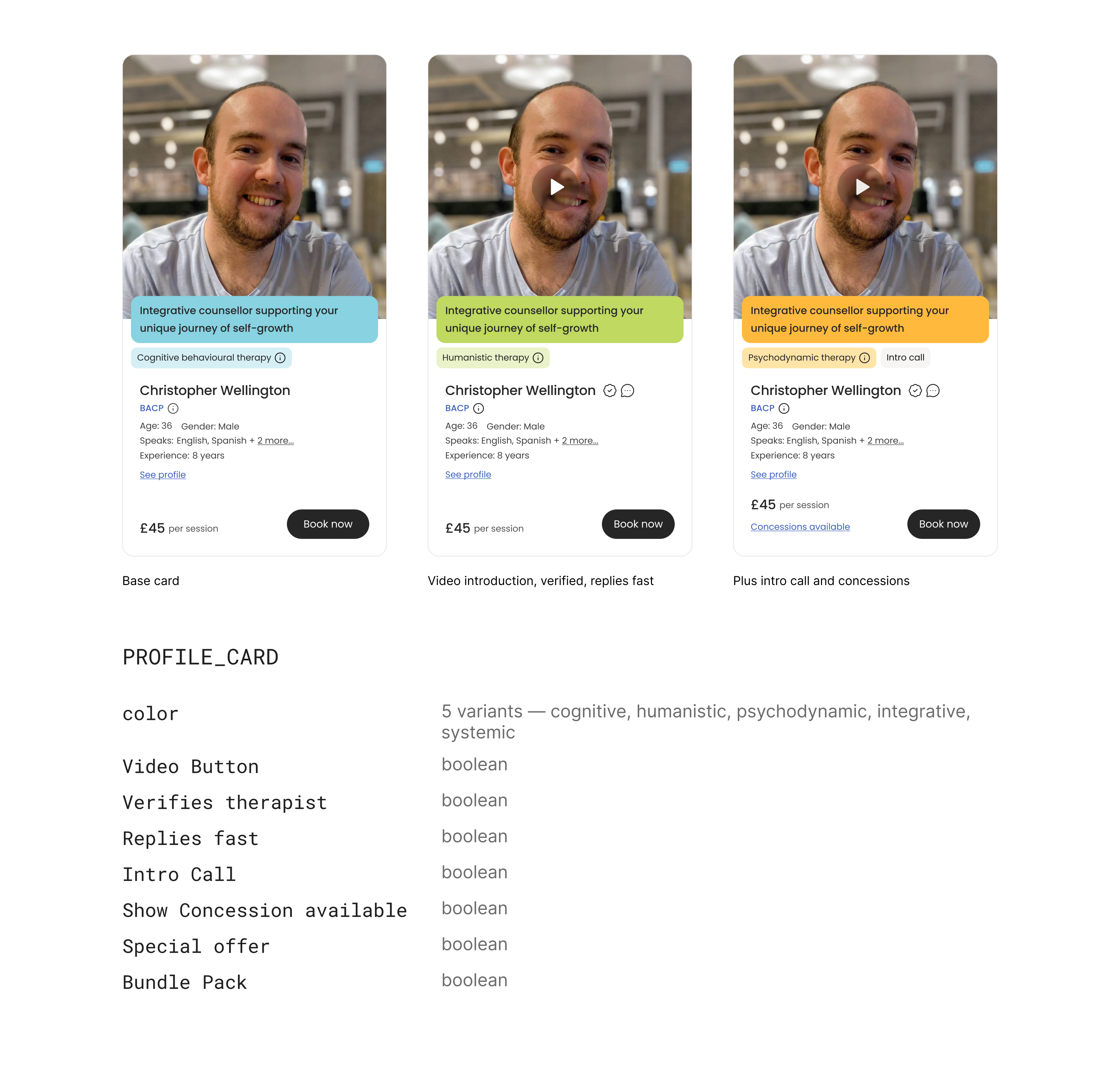
Components looked alike but behaved differently, and none of them were documented, so every release slowed down. I started with an audit rather than a redesign: I catalogued every component across both sides of the marketplace and ordered the rebuilds by how often a pattern appeared and how much rework it was causing in build. The principle throughout was that the engineers are the users of the system — a component was finished when it was faster to implement than the one it replaced.
What I changed
- Audited the existing library and ordered the rebuilds by how often each pattern appeared and what it cost to build
- Rebuilt each component with its full set of states, so behaviour was decided in design rather than in a ticket
- Defined spacing, type and colour as named tokens shared with the codebase, and built WCAG AA contrast and focus states into each component
- Paired with the engineers to adapt the library for React, so anything awkward to build changed in the design rather than being worked around in code
The audit mattered more than the redesign. Knowing which components were costing the team most told us where the system would actually pay back.
Outcome
Confidence, and a flow people could finish
The redesign shipped to production, built on a React design system I established with the engineering team. Research bracketed the work: interviews before I began, a second round reviewing the first redesign, and moderated usability testing with 50 participants at the end. The second interview round confirmed people felt more confident about choosing a therapist, and every usability test participant completed the booking flow unaided. Those two results matter together: the engine worked, and the trust landed. Either one on its own would have left people browsing rather than booking.
What I'd measure next
- Conversion from profile view to booking
- Drop-off across each funnel stage
Key takeaways
- Trust has to be built at the very first step, not on the booking screen. Moving trust signals earlier — video intros, clear credentials — did more for confidence than anything I changed at the point of booking.
- Fewer options, more depth on each. The matching flow narrowed how many therapists someone considered, while the profiles gave far more detail on the ones that remained. Reducing choice and reducing information are not the same move, and this project needed opposite answers to each.
- Interviewing before and after changed what I built, not just what I validated. The first round told me trust was the real barrier; the second confirmed the redesign had shifted it. A task completion rate alone would never have shown me either.